
Girdwood to Indian Transmission Line Reconstruction Project
Stay in the know! Join our project specific email list!
Project Look-Ahead
The project construction contractor, Sturgeon Electric, is working to complete the remaining 2.97 miles of transmission line. The project includes 2.24 miles of transmission line between the bike path and the mountain base north of Bird Point and 0.73 miles of the Girdwood Tap. Below is a summary of work planned from January through March 2026, with Project completion expected in March.
January: In the section north of Bird Point, crews will drive piles, set new poles, install new conductors, and retire old structures. During this same period, work will take place on the Girdwood Tap, where a temporary line will be built to maintain service during construction.
A short outage is scheduled for January 29 from 12:01 to 4 a.m. to connect the Girdwood Substation to the temporary line, allowing crews to safely transfer (“cut over”) power so construction can continue.
February: Construction of the new transmission line will be completed, and the line will be reenergized. At the Girdwood Tap, a short outage will take place to transition the Girdwood Substation to the new permanent line, followed by the removal of the temporary line.
March: Crews will remove old piles, debris, and crane mats, complete right‑of‑way cleanup, and demobilize.
Project Overview
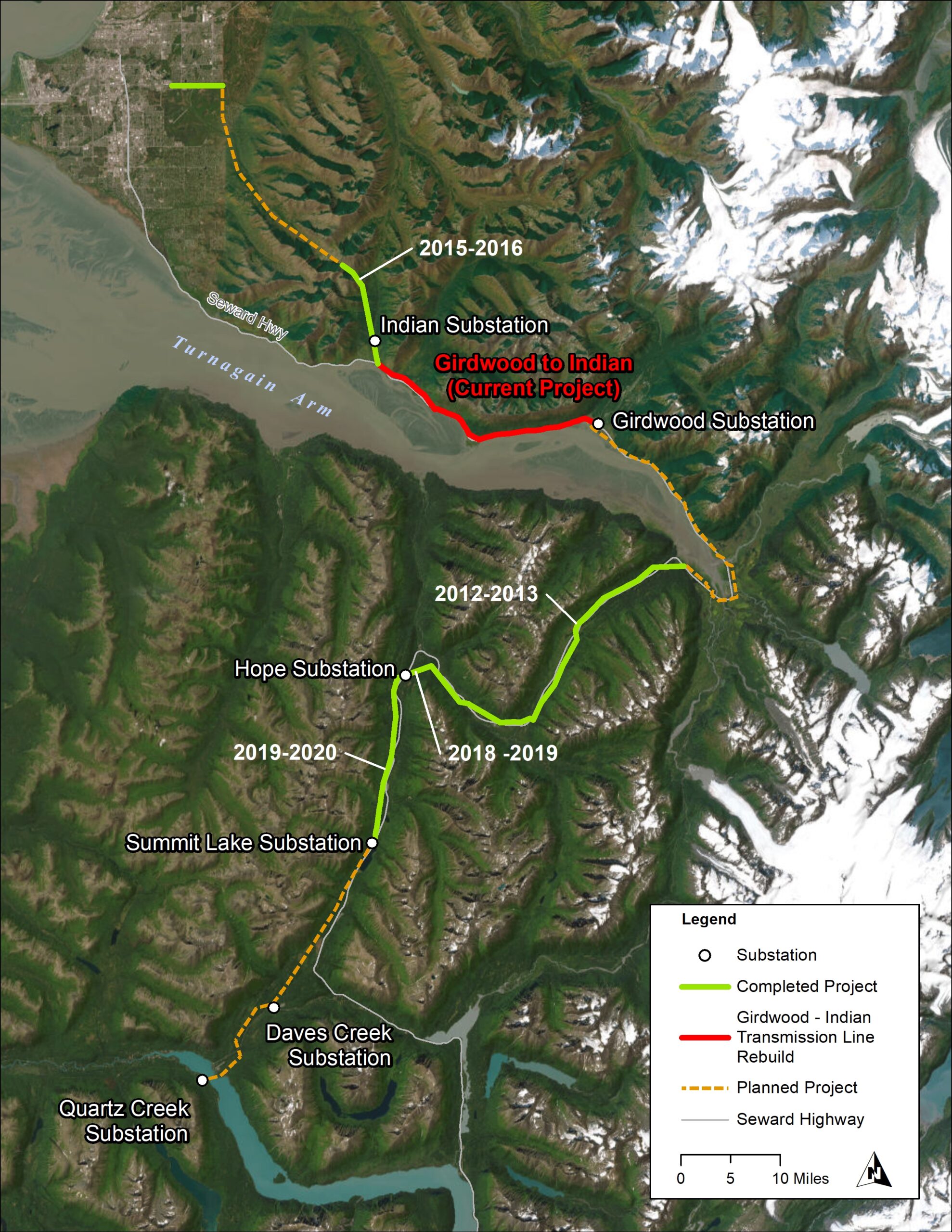
The Girdwood to Indian Transmission Line Reconstruction Project will replace 12 miles of transmission line between the Girdwood Substation and the Indian Substation. This transmission line was built 60 years ago, and the equipment is reaching the end of its service life. The Girdwood to Indian section is part of a larger ongoing project that began in 2004 to rebuild the transmission line from Anchorage to Cooper Landing and is necessary to continue providing safe, reliable power.
The project involves replacing new support structures and the electric conductor (i.e., wire) within the existing transmission line right-of-way (ROW) corridor and removing the old structures. The ROW corridor is 100 feet wide, with the transmission line situated generally down the center of the corridor. The project will also involve clearing overgrown vegetation to re-establish access to the ROW and within the ROW to maintain adequate clearance from the energized transmission line.
Girdwood to Indian Transmission Line Rebuild Video – Youtube
Project Area Map
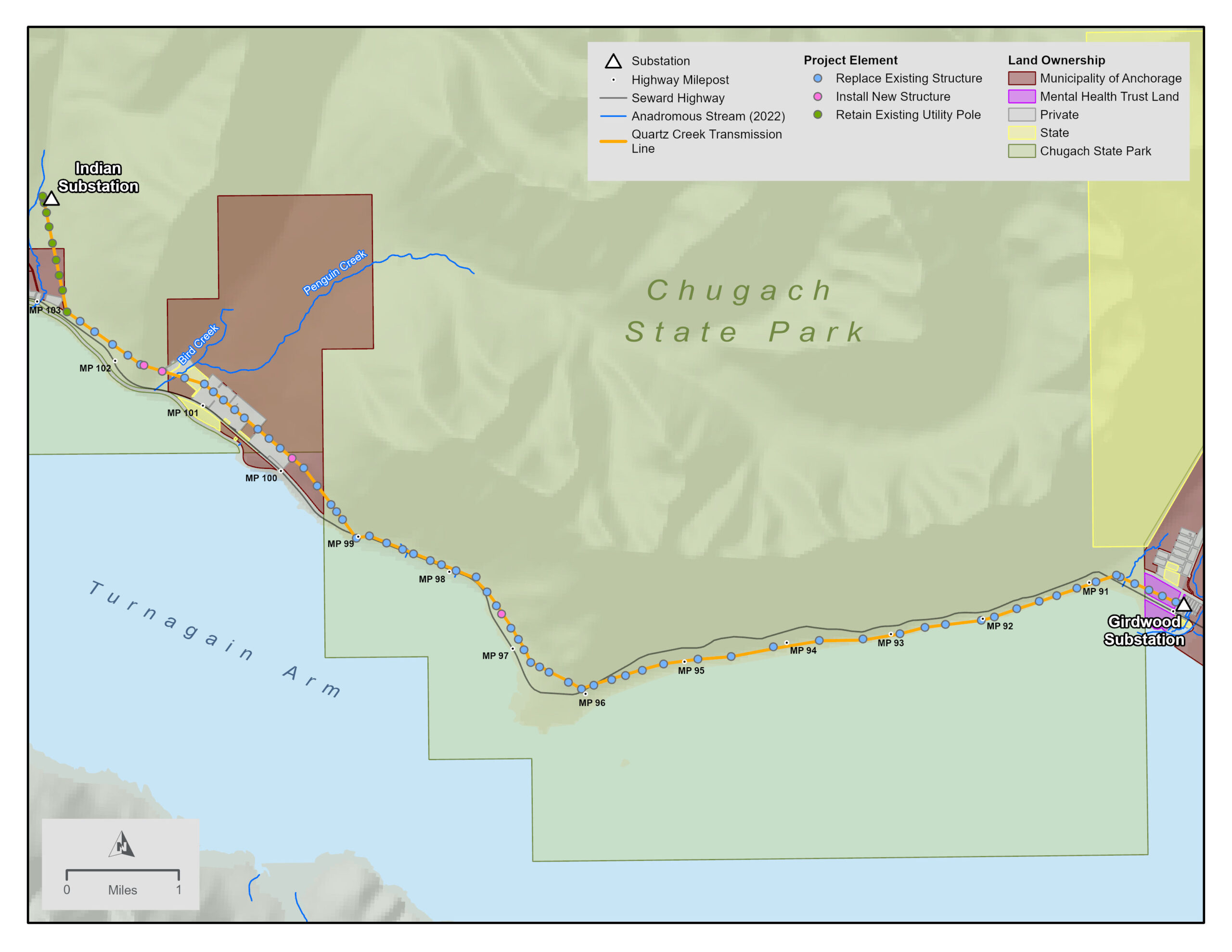
Project Overview Map
Frequently Asked Questions
1. What is Chugach Electric Association, Inc. (Chugach) proposing to do and where?
Chugach is reconstructing portions of the 90.4-mile-long Quartz Creek 115 kilovolt (kV) transmission line, which runs from the Cooper Lake Substation near Kenai Lake to Anchorage. As part of that effort, Chugach plans to rebuild a 12-mile-long segment of the transmission line located between the Girdwood Substation and the Indian Substation, beginning in 2023. The transmission line is generally situated near the center of its 100-ft-wide right-of-way (ROW) corridor, and the rebuilt line will also follow the existing ROW centerline.
2. Why is the project needed?
The Quartz Creek transmission line is a significant part of the power grid in Southcentral Alaska, carrying electricity generated by the Bradley Lake Hydroelectric Facility, which is Alaska’s largest source of carbon-free renewable power. The transmission line was initially constructed more than 60 years ago and inspections confirmed that many of the structures have reached the end of their useful life and need to be replaced to maintain safe, reliable power.
3. What does rebuilding a transmission line involve?
Chugach plans to install new utility structures (e.g., poles or towers) and remove the old structures. In most cases, each new structure will be located near the existing structure to be removed, except where current design standards require a change in location due to siting constraints (e.g., to avoid avalanche-prone areas). New utility structures will increase in height by an average of 25 feet and 3 feet in width for public safety and increased electric reliability. Structures will be placed to avoid avalanche zones where possible and additional strength will be added to structures placed within avalanche zones. To meet expected future electricity demand, the line will be rebuilt with a larger conductor. For modernization and resiliency purposes a fiber optic line will be added for faster equipment response times and system visibility.
4. Will this project impact the number and/or duration of power outages?
Chugach’s transmission system is established with redundant sources which allow for work to be performed with minimal disruption to our individual customers. Chugach does not anticipate any scheduled outages to customers over the course of this project.
5. Can the transmission line be buried underground?
Undergrounding this line would pose significant technical design and access challenges, as well as creating significant barriers to proper maintenance of the line and troubleshooting during outage conditions. Placing a transmission line underground in the Girdwood to Indian segment would be a 7-to-10-fold increase in construction and maintenance costs, which would largely be passed on to customers in the form of higher rates. For these reasons, undergrounding this transmission line has been deemed unfeasible.
6. What is the project timeline?
Chugach plans to start clearing overgrown vegetation in February 2023, begin construction shortly thereafter, and complete construction in 2024. Chugach plans to conduct most clearing and construction when the ground is frozen, which will be especially important when operating equipment to access and replace utility structures located in wetlands. Project elements located in upland areas can be constructed during any seasonal period. However, Chugach will avoid vegetation clearing from May 1 to July 15 to protect nesting migratory birds.
7. How will the project affect landowners adjacent to the transmission line?
The project ROW is primarily routed adjacent to public land. In the Bird Creek community, landowners with properties that abut the ROW may see and/or hear construction and vegetation crews while the crews are actively working on the segment.
8. Why does vegetation need be cleared and where will this occur?
Chugach is required to clear the ROW to maintain adequate clearance between the energized transmission line and vegetation. Chugach typically clears overgrown vegetation from the ROW and along access routes every 10 years for maintenance. Prior to rebuilding the line, Chugach must clear vegetation to reestablish currently overgrown access routes to the ROW and clear vegetation from within the ROW. Vegetation clearing will occur throughout the 100-ft wide ROW while access routes will require a 12-ft maximum clearing width. Buffering zones will be retained at stream crossings. Vegetation clearing methods will include mechanical clearing, hand clearing, or a combination of both, depending on site conditions.
9. Will the project affect traffic on the Seward Highway?
Chugach is working with the Alaska Department of Transportation and Public Facilities (DOT&PF) to minimize disrupting traffic flow on the Seward Highway. Replacing the utility towers that run directly adjacent to the Seward Highway will require temporary lane closures to allow the ingress and egress of heavy equipment as well as to maintain a safe work environment during construction. When possible, work on the towers will avoid the summer driving period and/or weekends when traffic volumes are their highest.
10. Will the project affect wildlife, natural areas, or recreational resources?
Chugach has developed several measures to avoid and/or minimize potential impacts on wetlands, streams, water, and wildlife. Prior to construction, a wildlife biologist will survey the area to identify potential bear dens and eagle nests so impacts can be avoided. Work that requires crossing wetlands or water will occur primarily in winter when the ground/water is sufficiently frozen. Low-pressure ground equipment and/or distributed weight matting will be used where necessary. Vegetative buffers will be maintained along streams, and a storm water pollution prevention plan will be implemented. There may be temporary trail closures when working in close proximity to a trail.
Close All
Project Related Documents
Adobe Acrobat Reader is required to view the below documents. You may download a free copy at Get Adobe Acrobat.
Public Meeting Materials
March 2024
Jauary 2023